Pioneering next-generation transport network architecture for 5G and beyond.
Project Overview
This project involved spearheading the research, architecture design, and initial development phases for Sliced Packet Networks (SPN) technology. SPN represents a revolutionary approach, enabling the creation of multiple, isolated logical networks ("slices") with guaranteed performance characteristics (bandwidth, latency, jitter) over a shared physical packet network infrastructure. This was identified as a critical enabler for meeting the diverse service requirements of 5G.
Role: Technology Strategy, Lead Architect, R&D Leadership
Domain: Data Networks, Transport Networks, 5G
Core Technologies: Network Slicing, QoS Mechanisms, Packet Transport (MPLS/Ethernet enhancements), Control Plane Architecture, Time-Sensitive Networking (TSN) concepts.
The Challenge
Traditional packet networks (like IP/MPLS) offer flexibility but struggle to provide the deterministic performance guarantees (hard bandwidth, bounded low latency) required by emerging applications, particularly those driven by 5G (e.g., URLLC for industrial automation or autonomous vehicles, eMBB for high-bandwidth video). Conversely, legacy TDM networks offered guarantees but lacked packet efficiency and flexibility. The challenge was to bridge this gap and develop a packet-based transport technology that could:
Support diverse services with vastly different performance needs (bandwidth, latency, reliability) on a single infrastructure.
Provide hard isolation between these services to prevent interference.
Offer quantifiable Service Level Agreements (SLAs) comparable to TDM networks.
Maintain the efficiency and scalability benefits of packet switching.
Integrate seamlessly with 5G RAN and Core architectures.
Solution Developed: SPN Architecture
Led the architectural definition of an SPN solution focused on combining packet flexibility with TDM-like guarantees through network slicing. The core concepts included:
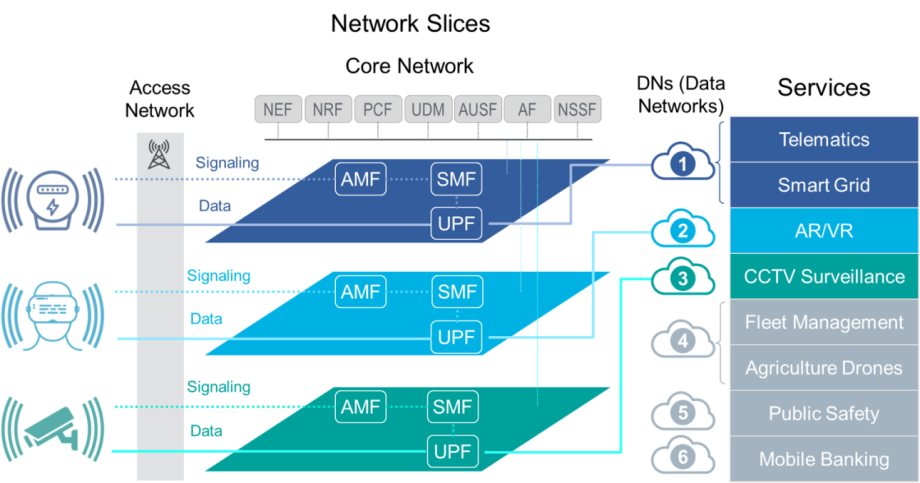
Fig 1: Conceptual view of SPN enabling multiple service slices on one network.
Fine-Grained Slicing: Defining mechanisms to partition network resources (bandwidth, buffer space, processing) into isolated slices, extending end-to-end across the transport network.
Hard Isolation Guarantees: Implementing advanced QoS mechanisms, traffic shaping, and scheduling algorithms within the data plane to enforce strict performance boundaries for each slice, ensuring committed bandwidth and low latency/jitter.
Enhanced Packet Transport Layer: Designing modifications or extensions to existing packet technologies (like Ethernet or MPLS) to incorporate time-sensitivity and deterministic forwarding characteristics, drawing inspiration from standards like IEEE 802.1 TSN.
Slice Management & Control Plane: Architecting a control and management plane capable of slice creation, modification, deletion, resource allocation, path computation (potentially via PCE), and monitoring per-slice performance.
Synchronization: Incorporating mechanisms for precise time synchronization (like PTP/SyncE) essential for 5G fronthaul and other time-sensitive applications within slices.
This architecture aimed to provide a converged, efficient, and highly flexible transport network capable of supporting the evolution towards 5G and beyond.
Key Technologies & Standards Alignment
The SPN architecture drew upon and aimed to align with several key technologies and industry standards:
Network Slicing Concepts: Aligned with 3GPP definitions for end-to-end network slicing.
Packet Transport: Enhancements built upon established Ethernet and MPLS principles.
Time-Sensitive Networking (TSN): Incorporated concepts from IEEE 802.1 TSN standards for deterministic low-latency communication.
Deterministic Networking (DetNet): Considered principles from IETF DetNet working group for guaranteed delivery.
Control Plane Technologies: Explored integration with SDN controllers and Path Computation Elements (PCE).
Synchronization Standards: Leveraged ITU-T recommendations for PTP (Precision Time Protocol) and SyncE (Synchronous Ethernet).
Potential Applications & Outcomes
The development of SPN technology unlocks significant capabilities and business benefits:
Converged 5G Transport: Providing a unified transport layer capable of simultaneously supporting eMBB (high bandwidth), URLLC (ultra-low latency), and mMTC (massive connections) service slices.
New Service Offerings: Enabling operators to offer differentiated, SLA-backed connectivity services tailored to specific enterprise needs (e.g., guaranteed low latency for financial trading, high bandwidth for cloud access).
Operational Efficiency: Reducing the need for multiple overlay networks by consolidating diverse services onto a single, intelligently managed infrastructure.
Resource Optimization: Efficiently utilizing network resources through statistical multiplexing while still providing hard guarantees where needed.
Foundation for Future Services: Creating a flexible platform adaptable to future network demands, including industrial IoT, V2X communication, and tactile internet applications.
This pioneering work laid the groundwork for next-generation transport networks designed to be agile, efficient, and capable of supporting the stringent requirements of future digital services.