Developing comprehensive enterprise software from the ground up.
Project Overview
This initiative involved the strategic leadership, architecture design, and development oversight of a comprehensive suite of enterprise business applications, including Enterprise Resource Planning (ERP), Supply Chain Management (SCM), Customer Relationship Management (CRM), and Business Process Management Systems (BPMS). Unlike relying on standard off-the-shelf software, these solutions were engineered from scratch to provide tailored functionality, superior integration, and adaptability for specific operational needs across various industries.
Many organizations, particularly in sectors like specialized manufacturing, government, and education, found that existing large-scale ERP/CRM solutions were often too rigid, expensive to customize, or failed to adequately address unique operational workflows and regulatory requirements. The challenge was to create a powerful, integrated alternative that offered:
Deep customization capabilities without excessive cost or complexity.
Seamless data flow between core business functions (finance, operations, sales, HR).
Scalability to support growth and evolving business needs.
Modern architecture principles for maintainability and future enhancement.
Industry-specific functionality built into the core design.
Solution Developed
Led the strategy and development teams to build a suite of interconnected business applications based on a flexible, modular architecture. Key development principles included:
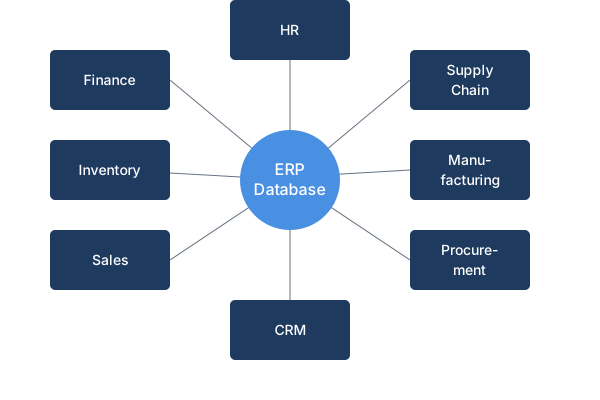
Fig 1: Conceptual diagram illustrating the modular and integrated nature of the suite.
From-Scratch Development: Avoiding legacy constraints by designing core modules and frameworks based on first principles and modern software engineering practices.
Modularity: Creating distinct but interoperable modules for ERP (Finance, HR, Inventory, Manufacturing, Procurement), SCM (Demand Planning, WMS, TMS), CRM (Sales, Marketing, Service), and BPMS (Workflow, Rules Engine).
API-First Integration: Designing comprehensive APIs to facilitate smooth data exchange between modules and integration with third-party systems.
Customization Framework: Building in mechanisms for efficient tailoring to specific industry verticals and client requirements without compromising the core codebase.
User-Centric Design: Focusing on intuitive interfaces and workflows to maximize user adoption and productivity.
This approach resulted in a powerful platform that could be configured as a complete suite or deployed modularly based on client needs.
Retail: Enabled omnichannel operations, advanced merchandising, and integrated customer engagement.
Outcomes typically included significant improvements in operational efficiency, reduced manual processes, enhanced data visibility for decision-making, increased process compliance, and a lower total cost of ownership compared to heavily customized COTS (Commercial Off-The-Shelf) solutions.