My extensive involvement in the telecommunications sector encompasses the full lifecycle of network infrastructure development – from pioneering high-capacity switching systems and ensuring rigorous standards compliance to developing innovative wireless access solutions that connect millions. The focus has consistently been on building reliable, scalable, and future-proof networks that drive connectivity and enable new services.
Core Switching Systems & Validation
The heart of any robust telecom network lies in its switching capabilities. My experience includes leading the design and development of advanced switching solutions, alongside the critical testing and compliance verification systems necessary to ensure network integrity and interoperability.
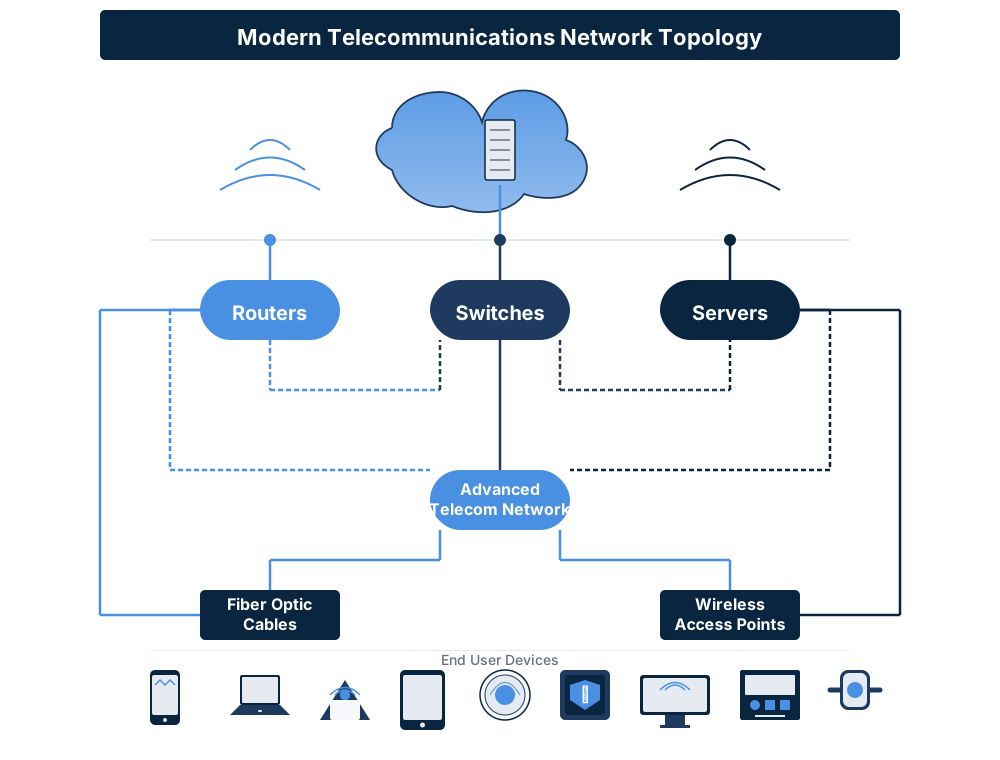 Fig 1: Conceptual high-level switching architecture.
Key Areas of Development:
- Advanced Switching Platforms: Architecting next-generation soft switch solutions designed for packet-based networks, supporting protocols like SIP, H.323, and MGCP while ensuring seamless interworking with legacy SS7 and ISDN networks. Focused on high availability, advanced routing logic, and comprehensive billing integration (CDR generation).
- Switching System Testers: Engineering comprehensive validation platforms capable of simulating real-world traffic and signaling (SS7, ISDN, SIP) at scale. These systems enabled automated test execution, real-time analysis, and detailed reporting, significantly improving network reliability and reducing time-to-market for new switch deployments.
- Compliance Verification Systems: Developing specialized systems to rigorously test telecom switch compliance against stringent ITU-T standards. These involved high-volume call generation across multiple protocols and configurable scenarios to guarantee interoperability and adherence to international specifications.
These initiatives were crucial for service providers seeking to modernize their core networks, ensuring stability while transitioning towards more flexible, IP-based architectures.
Protocol Analysis & Transmission Technologies
Efficient and reliable data transport is paramount. My work extended to creating sophisticated protocol analysis tools for deep network visibility and developing optical transmission systems optimized for performance and evolving network demands.
Key Areas of Development:
- Multi-Protocol Analyzers: Designing powerful diagnostic tools providing deep packet inspection and real-time decoding for a wide range of telecom and data protocols (including CAS, SS7, IP/MPLS, SIP). Features included advanced filtering, call/session tracing, performance metrics, and security analysis capabilities, essential for troubleshooting, optimization, and validation.
- PDH Optical Transmission Systems: Engineering robust and cost-effective Plesiochronous Digital Hierarchy (PDH) optical systems for multiplexing multiple E1/T1 circuits over fiber. These systems incorporated built-in performance monitoring, redundancy options, and network management integration for reliable point-to-point transport.
- AI-Enhanced Optical Transmission: Exploring and integrating artificial intelligence techniques into next-generation optical systems to enable automated parameter optimization, predictive maintenance based on optical performance data, dynamic capacity allocation, and enhanced spectral efficiency, paving the way for smarter, self-optimizing transport networks.
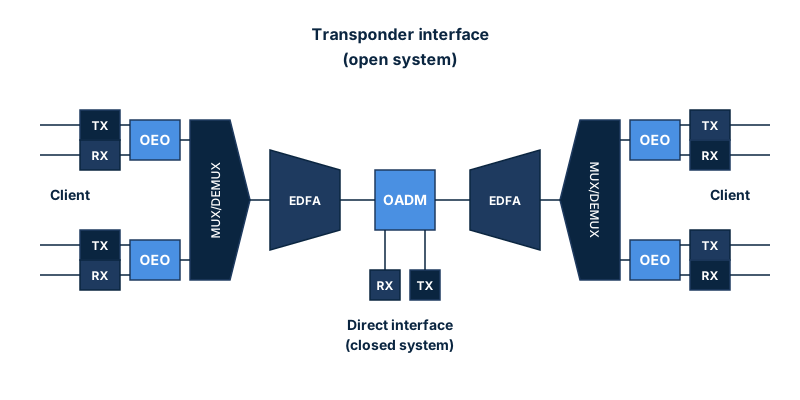 Fig 2: Visualization of optimized optical data flow.
These solutions provided network operators with the necessary tools for both maintaining existing infrastructure and embracing advancements in optical transport efficiency.
Wireless Access & Service Platforms
Extending connectivity and enabling service delivery at scale requires innovative access solutions. Key projects involved developing specialized wireless systems for underserved areas and building robust platforms capable of managing millions of subscribers.
Key Areas of Development:
- DECT-WLL Systems: Creating Digital Enhanced Cordless Telecommunications (DECT) based Wireless Local Loop (WLL) systems specifically designed for rural communications. These cost-effective solutions offered extended coverage (up to 10km), utilized compact subscriber terminals, interfaced with central exchanges, and included options for off-grid solar power, bridging the digital divide.
- Large-Scale Pre-Paid Service Platforms: Architecting and overseeing the development of comprehensive, end-to-end service provider platforms supporting over 10 million pre-paid voice and data subscribers. These systems featured real-time charging, flexible service bundling, multi-channel voucher distribution, customer self-service portals, and advanced fraud detection mechanisms.
- Foundation for 5G Solutions: Leveraging core network and access technology expertise to contribute to the development roadmap for 5G, including concepts around edge aggregation, integrated DU/CU architectures, and ensuring transport networks meet the demanding latency and bandwidth requirements of 5G use cases.
These initiatives directly impacted millions of users, providing essential connectivity and demonstrating the ability to build and manage platforms operating at significant scale and complexity.