Project Overview
This project focused on designing and developing a Wireless Local Loop (WLL) system based on the Digital Enhanced Cordless Telecommunications (DECT) standard, specifically optimized for providing basic telephony services in rural and remote areas with limited or non-existent fixed-line infrastructure. The objective was to create a reliable, cost-effective, and easily deployable solution to connect underserved communities.
The Challenge
Providing telecommunications infrastructure in rural areas presents unique obstacles:
- High Cost of Fixed Lines: Laying copper or fiber cables over long distances to sparsely populated areas is often economically unviable.
- Geographical & Terrain Difficulties: Remote locations often involve challenging terrain, making infrastructure deployment difficult and expensive.
- Lack of Power Infrastructure: Consistent electrical power supply may be unreliable or unavailable in certain areas.
- Need for Robustness & Low Maintenance: Equipment deployed in remote locations must be durable and require minimal maintenance.
- Affordability: The solution needed to be affordable for both the operator deploying it and the end-users in low-income regions.
Solution Developed: DECT-Based WLL System
Led the development of a WLL system leveraging the mature and cost-effective DECT standard, optimizing it for fixed wireless access in rural environments. The system architecture comprised:
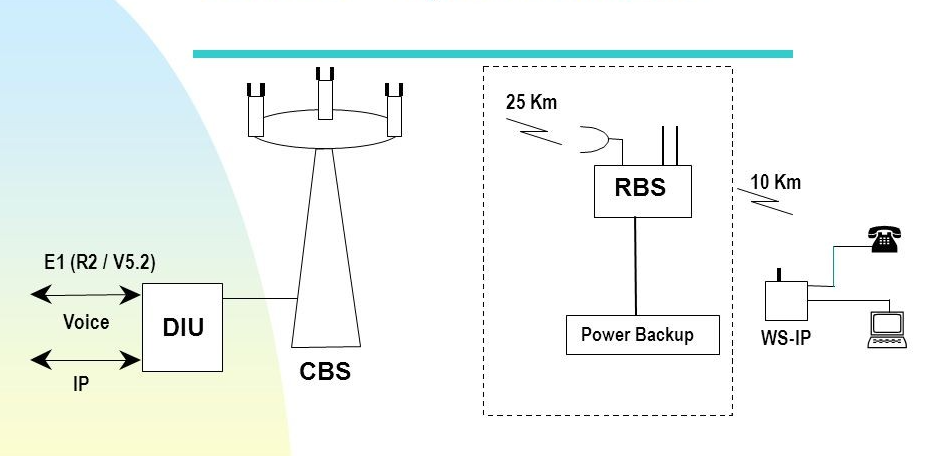 Fig 1: System architecture of the DECT-WLL solution.
- Central Base Station Controller (BSC): Connected to the Public Switched Telephone Network (PSTN) via standard interfaces (e.g., V5.x or analogue POTS lines). Managed radio resources and call control for multiple radio base stations.
- Radio Base Stations (RBS): Deployed strategically to provide radio coverage over a target area. Utilized the DECT frequency band (typically 1.9 GHz).
- Fixed Subscriber Terminals (FSTs): Compact, durable terminals installed at the subscriber premises. Contained DECT radio and a standard telephone interface (RJ11) for connecting a regular phone handset.
- Extended Range Capabilities: Employed techniques like directional antennas (at both RBS and FST) and potentially optimized radio parameters to achieve significantly longer ranges (up to 10km line-of-sight) compared to standard indoor DECT applications.
- Low Power Consumption: Designed both base stations and subscriber terminals for low power usage, enabling operation with battery backup and optional solar power systems for off-grid deployment.
- Simplified Management: Included basic remote management capabilities for monitoring system status and subscriber lines.
The use of the globally recognized DECT standard ensured availability of low-cost chipsets and interoperability knowledge, contributing to the overall affordability of the solution.
Outcomes & Impact
The DECT-WLL system provided a viable and impactful solution for rural connectivity:
- Bridged the Digital Divide: Successfully extended basic voice telephony services to thousands of households and small businesses in previously unconnected rural communities.
- Cost-Effective Deployment: Offered a significantly lower deployment cost per subscriber compared to traditional fixed-line infrastructure in target areas.
- Rapid Deployment: Wireless nature allowed for much faster network rollout compared to trenching cables.
- Reliable Service: Provided stable voice communication suitable for essential community needs.
- Off-Grid Capability: Solar power options enabled deployment in areas completely lacking electrical grid access.
- Socio-Economic Benefits: Facilitated communication for commerce, education, healthcare access, and social connection in underserved regions.
This project demonstrated the successful adaptation of existing wireless technology to meet specific socio-economic needs, delivering essential services through practical and innovative engineering.